






Improving Water and Fertiliser Use Efficiency the Natural Way - HortiHydrate Bio
- by Hortifeeds Agronomist Mike Wainwright
Following the easing of pandemic restrictions, 2022 was supposed to be the ‘return to normality’, where we collectively pick up from where we left off at the start of 2020 – how wrong was that assumption! We are all seeing the cascading repercussions of the war in Ukraine and the sanctions against Russia and its allies, and how these are causing a seismic shift in resource availability and cost throughout the world. With available natural resources dwindling, and production costs spiralling, this is creating a perfect storm for consumers everywhere. It’s also an increasing headache for growers in trying to provide affordable edible and ornamental crops for us consumers, using cost effective production methods.
Farmers and growers will be only too well aware of the huge hikes in fertiliser prices seen over the past year. After a period of relative price stability, it’s come as quite a shock to the system to be confronted with such rapid changes. Water is also becoming more of a scarce and costly resource in many areas, with climate change producing more extreme weather events, such as the repeated recent summer droughts throughout the country.
Consequently, growers are searching more than ever before for ways of getting the most they can out of every input cost. It can be a struggle just keeping plants alive during extreme hot spells, so ensuring water and nutrients are available evenly throughout the growing media and avoiding dry spots, where media becomes hydrophobic and doesn’t absorb water readily, are key issues to overcome. Adding surfactant wetting agents to irrigation or fertigation water is a well-known and straightforward way to ensure water and dissolved nutrients are used with the best possible efficiency. These products aid the distribution of water and nutrients in growing media or soil and improve availability for uptake by plants. For this reason, synthetic wetting agents are often regarded as ‘environmentally friendly’ products as they can reduce wastage and improve use efficiency. ‘Environmentally friendly’ has been an often used (some might say overused!) tag line for many years now, but just how environment friendly are these synthetic surfactant products? Being made from fossil fuels they certainly aren’t made from sustainable resources, and it was a surprise to me when I was made aware that the co-polymers used to formulate these standard wetting agents are actually classed as plastics! Whilst these are in liquid form rather than the small fragments referred to as microplastics, it’s yet another artificial chemical released into the environment, to add to the many other pollutants potentially causing damage to ecosystems.
Growers with organic certification, and those looking to use more environmentally friendly methods, have been using extracts of the Yucca plant as wetting agents for many years. Yucca plants naturally grow in harsh arid environments, and one of the ways they have adapted to these conditions is to produce a thick lipid (oily) sap containing chemicals known as saponins. These saponins have been shown to act as natural surfactant wetting agents, but the performance of these extracts is not in any way comparable to the synthetic options available, so their effects could be accurately described as ‘better than nothing’!
Some commercial Yucca formulations also include synthetic components to improve their performance, making these products neither environmentally friendly nor anywhere near as effective as fully synthetic wetters, which could be described as a bad compromise!

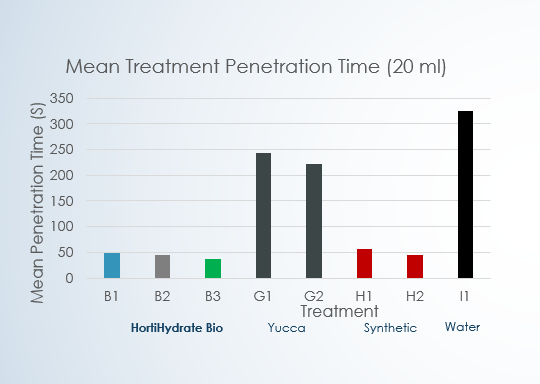
Working with leading experts in surfactant technology, we have developed HortiHydrate Bio, a revolutionary new wetting agent made entirely from natural and sustainable materials. Extensive trials of HortiHydrate Bio have shown its efficacy is comparable to synthetic wetting agents, and vastly superior to Yucca extract products. Tests have included infiltration (water penetration) times, spreading and re-wetting capabilities, and longevity of performance.
The table below shows the infiltration times of 3 rates of HortiHydrate Bio, compared with water alone, Yucca extracts and an industry standard synthetic wetting agent:
HortiHydrate Bio has been approved for use in organic growing systems by The Soil Association, demonstrating its sustainable, environmental credentials.
Growers can now access the advantages of the latest wetting agent technology without costing the earth – better for plants, better for the planet.
If you would like to know more about HortiHydrate Bio, please contact us here or speak to your local Sales Manager or come and talk to us at FruitFocus 2022 on 13th July, stand 504

Share this page


